
As industrial equipment becomes smarter and more automated, optical sensors are playing an increasingly important role in how machines see, measure, and respond to their surroundings. The performance of these sensors often depends on precise control of the wavelengths of light reaching the sensing element.
Specialty functional dyes enable control of how materials interact with light across the ultraviolet (UV), visible, and near-infrared (NIR) spectra. By selectively absorbing, transmitting, or attenuating specific wavelengths, these dyes can help improve sensor accuracy, reliability, and repeatability while reducing interference from unwanted light.

Photoelectric and proximity sensors are good examples. These systems rely on controlled optical signals to detect the presence, position, and movement of objects. Dyes formulated for wavelength-specific filtering can reduce interference from ambient light while allowing the desired wavelengths from common industrial emitters to pass through. They can also be incorporated directly into clear or transparent polymers used for sensor windows, covers, lenses, and other optical components.
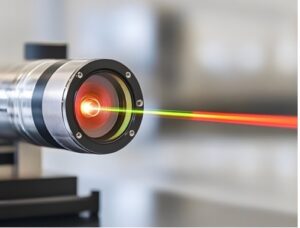
Light management is equally important in machine vision and automated inspection systems, where unwanted or reflected light can interfere with image quality and measurement accuracy. Functional dyes can be incorporated into camera filters, sensor windows, illumination components, and light-managed housings to improve optical contrast and produce a cleaner, more consistent signal. This can benefit automated inspection, measurement, sorting, and quality-control systems operating in demanding production environments.

Functional dyes also support infrared and near-infrared sensing technologies used in LiDAR, distance measurement, object detection, robotics, and material identification. Dye formulations can be engineered to selectively transmit or block specific NIR wavelengths while maintaining the desired visible appearance of the component. This makes them useful for NIR-pass filters, sensor covers, IR monitoring systems, and components used throughout automated equipment.
An additional advantage is the ability to build optical performance directly into the material or finished component. Dyes can be used with a range of polymers, epoxies, inks, and coatings, and are compatible with manufacturing processes such as injection molding, extrusion, coating, overmolding, printing, and marking. This gives manufacturers flexibility in determining how optical filtering is incorporated into a sensor or system.
Developing the right solution, however, involves more than selecting a dye. Make sure your functional dye supplier, like Epolin, provides technical and spectral data, computer modeling of dye formulations to meet specific optical targets, formulation assistance, and support from initial prototyping through production scale-up.
Epolin’s dyes manage light for photoelectric sensors, machine vision, robotics, LiDAR, industrial process monitoring, and more. Epolin’s goal is to develop the best functional dye solution for your demanding industrial applications. Contact us to discuss your sensor application and specific wavelength requirements: https://epolin.com/contact-us/
Share with your friends
